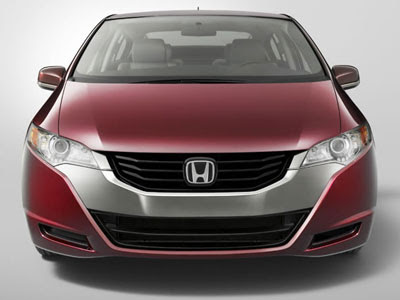
Honda has actually applied the FCX badge to several vehicles. The outgoing model is a chunky-looking Japanese hatchback. The new edition is decidedly more stylish - and roomy. Honda has learned a valuable lesson from its Japanese rival, Toyota , whose Prius is a distinctive visual standout.
The Honda FCX Clarity takes the layout and design themes first seen in two years ago in the FCX concept to completion.
While facilities for retail distribution of hydrogen are obviously extremely limited right now, Honda is actively working to change that too. Honda Soltec recently started production of new photo-voltaic cells that only require half the energy input to manufacture of current cells. Their Torrance, CA headquarters campus has a hydrogen filling station that features two different H2 generators. A solar powered electrolyzer produces the gas from water, while the experimental Home Energy Station has a natural gas reformer.
With the most common way of producing hydrogen right new is steam reformation of natural gas, CO2 emissions still remain a concern. However, when well-to-wheels CO2 emissions are evaluated in comparison to gasoline engines, steam reformation and fuel cells show a sixty percent reduction. For solar powered electrolysis, Honda has proton exchange membrane electrolyzer that basically functions as a fuel cell in reverse and is eighty percent efficient. Although home hydrogen generation is still a ways off, centrally produced hydrogen is being distributed via pipelines right now. Shell will open be opening a hydrogen station in Los Angeles next year right on an existing 8" hydrogen pipeline.
Exterior Design Leader Masaru Hosagawa explained that the body of the new FCX was specifically designed to highlight the tiny drive-train that propels this relatively large car. The FCX takes the cab forward design ethos to a whole new level with the base of the windshield starting at about the front wheel center line and sweeping all the way back to the edge of the trunk lid in a continuous curve dubbed Dynamic Full Cabin Design. Combined with the super compact vertical flow fuel cell stack that sits within the center console, the FCX has an almost limousine-like interior volume for four passengers.

Speaking of the passengers, keeping them in climate-controlled comfort is important but regulating the temperature of such a large interior volume can consume quite a bit of energy. One way to minimize that energy is to regulate the temperature right at the surface of the occupants. Since the largest point of contact between the passengers and the car is the seats, Honda has chosen to provide a climate control system within the seats. Fans draw air into the front seats where a thermo-electric device chills or heats it before blowing it through pores in the seat cushions. The end result is greatly reduced demand on the climate control system.
The FCX Clarity has remained remarkably true to the concept with the most obvious visual difference being the nose. The production car has been stretched out by a few inches in order to provide crush space for crash protection. The grille has now been moved above a new chrome bumper strip taking the place of the previous full-width light bar. In profile the base of the windshield extended even farther forward and the front quarter windows were part of the body. Those windows are now smaller and integrated into the doors instead. At the back, the full width tail-lamp cluster is now slimmer in the middle providing room for an extra piece of vertical glass aiding rear visibility with the high deck.
That tall deck combines with a fuel tank mounted down low between the rear wheels to provide for much more trunk room than other converted fuel cell cars. Including the under floor compartment, the total storage volume is 13.1 cu. ft. The fully-appointed FCX is equipped with all the modern conveniences such as a satellite navigation system, adaptive cruise control, electronic stability control. All of this is combined in an aluminum structural cage that provides protection for the passengers and the fuel system.

The FCX platform as having been designed to be lightweight while providing maximum safety. The FCX is designed to meet and surpass all safety standards in the US and elsewhere. When this car becomes available next year, it won't require any safety waivers. The 5,000 psi hydrogen tank is designed to withstand any impact it might see in the real world. While the first generation FCX used a two tank storage system, the new car has switched to a single-tank setup. Previously separate components like the pressure sensor, regulator and shut-off valve are now combined in one module mounted in the tank.
Having only one tank means fewer connection points that can fail so that safety is enhanced and installation is a lot simpler. A single larger diameter tank has greater capacity in less overall space than two smaller tanks. The bottom line is seventy-four percent fewer parts and twenty-four percent better storage efficiency.
One problematic aspect of many previous fuel cell vehicles has been high weight. The Chevrolet Equinox Fuel Cell being used for that company's Project Driveway weighs over 4,400 pounds and the Sequel concept reportedly weighs over 5,000 lbs. Even the much smaller Ford Focus FCV weighs in at 3,600 lbs. The new FCX Clarity weighs in at 3,582 lbs, which is only about 175 lbs more than the similarly-sized 2008 Accord. Doing a ground up design around a fuel cell power-train has allowed Honda to optimize it for the purpose.

The FCX is extremely well-equipped, overall, with niceties such as dual-zone digital climate control, adaptive (radar) cruise control, voice-activated navigation, and a sweet AM/FM/CD/XM audio system with a jack for your iPod or MP3 player.
That pays off in the ride and handling of the Clarity. While some other cross-over type fuel cell vehicles definitely feel more truck like on the road, this car is pure Honda. The FCX Clarity will be available for lease to retail customers beginning in the summer of 2008.
While facilities for retail distribution of hydrogen are obviously extremely limited right now, Honda is actively working to change that too. Honda Soltec recently started production of new photo-voltaic cells that only require half the energy input to manufacture of current cells. Their Torrance, CA headquarters campus has a hydrogen filling station that features two different H2 generators. A solar powered electrolyzer produces the gas from water, while the experimental Home Energy Station has a natural gas reformer.
With the most common way of producing hydrogen right new is steam reformation of natural gas, CO2 emissions still remain a concern. However, when well-to-wheels CO2 emissions are evaluated in comparison to gasoline engines, steam reformation and fuel cells show a sixty percent reduction. For solar powered electrolysis, Honda has proton exchange membrane electrolyzer that basically functions as a fuel cell in reverse and is eighty percent efficient. Although home hydrogen generation is still a ways off, centrally produced hydrogen is being distributed via pipelines right now. Shell will open be opening a hydrogen station in Los Angeles next year right on an existing 8" hydrogen pipeline.
Exterior Design Leader Masaru Hosagawa explained that the body of the new FCX was specifically designed to highlight the tiny drive-train that propels this relatively large car. The FCX takes the cab forward design ethos to a whole new level with the base of the windshield starting at about the front wheel center line and sweeping all the way back to the edge of the trunk lid in a continuous curve dubbed Dynamic Full Cabin Design. Combined with the super compact vertical flow fuel cell stack that sits within the center console, the FCX has an almost limousine-like interior volume for four passengers.
Speaking of the passengers, keeping them in climate-controlled comfort is important but regulating the temperature of such a large interior volume can consume quite a bit of energy. One way to minimize that energy is to regulate the temperature right at the surface of the occupants. Since the largest point of contact between the passengers and the car is the seats, Honda has chosen to provide a climate control system within the seats. Fans draw air into the front seats where a thermo-electric device chills or heats it before blowing it through pores in the seat cushions. The end result is greatly reduced demand on the climate control system.
The FCX Clarity has remained remarkably true to the concept with the most obvious visual difference being the nose. The production car has been stretched out by a few inches in order to provide crush space for crash protection. The grille has now been moved above a new chrome bumper strip taking the place of the previous full-width light bar. In profile the base of the windshield extended even farther forward and the front quarter windows were part of the body. Those windows are now smaller and integrated into the doors instead. At the back, the full width tail-lamp cluster is now slimmer in the middle providing room for an extra piece of vertical glass aiding rear visibility with the high deck.
That tall deck combines with a fuel tank mounted down low between the rear wheels to provide for much more trunk room than other converted fuel cell cars. Including the under floor compartment, the total storage volume is 13.1 cu. ft. The fully-appointed FCX is equipped with all the modern conveniences such as a satellite navigation system, adaptive cruise control, electronic stability control. All of this is combined in an aluminum structural cage that provides protection for the passengers and the fuel system.
The FCX platform as having been designed to be lightweight while providing maximum safety. The FCX is designed to meet and surpass all safety standards in the US and elsewhere. When this car becomes available next year, it won't require any safety waivers. The 5,000 psi hydrogen tank is designed to withstand any impact it might see in the real world. While the first generation FCX used a two tank storage system, the new car has switched to a single-tank setup. Previously separate components like the pressure sensor, regulator and shut-off valve are now combined in one module mounted in the tank.
Having only one tank means fewer connection points that can fail so that safety is enhanced and installation is a lot simpler. A single larger diameter tank has greater capacity in less overall space than two smaller tanks. The bottom line is seventy-four percent fewer parts and twenty-four percent better storage efficiency.
One problematic aspect of many previous fuel cell vehicles has been high weight. The Chevrolet Equinox Fuel Cell being used for that company's Project Driveway weighs over 4,400 pounds and the Sequel concept reportedly weighs over 5,000 lbs. Even the much smaller Ford Focus FCV weighs in at 3,600 lbs. The new FCX Clarity weighs in at 3,582 lbs, which is only about 175 lbs more than the similarly-sized 2008 Accord. Doing a ground up design around a fuel cell power-train has allowed Honda to optimize it for the purpose.
The FCX is extremely well-equipped, overall, with niceties such as dual-zone digital climate control, adaptive (radar) cruise control, voice-activated navigation, and a sweet AM/FM/CD/XM audio system with a jack for your iPod or MP3 player.
That pays off in the ride and handling of the Clarity. While some other cross-over type fuel cell vehicles definitely feel more truck like on the road, this car is pure Honda. The FCX Clarity will be available for lease to retail customers beginning in the summer of 2008.


No comments:
Post a Comment